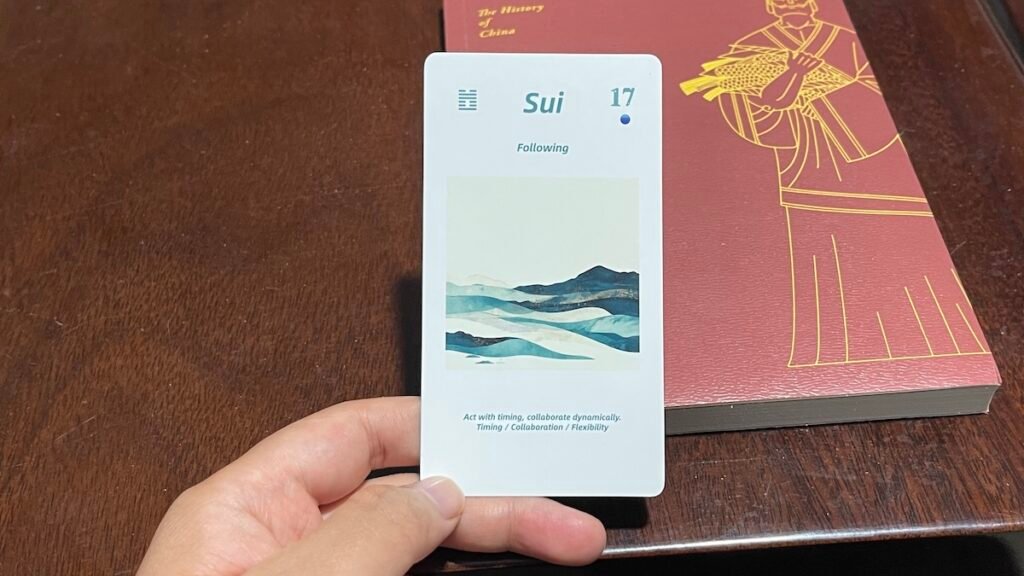
What Hexagram 17 (Following) Teaches About Timing, Choice, and Going With the Flow
- By YOWAYOW
Have you ever stood in line for coffee, watched the person in front of you switch to another queue, and hesitated?
You stay.
They move.
Their line suddenly speeds up — and you’re still waiting.
It’s a small, forgettable moment.
But it reveals a question we face again and again in life:
When should I follow — and when should I stay where I am?
This is exactly what Hexagram 17, Following (随卦) in the I Ching is about.
View more interpretations of Hexagram Sui
Following Is Not Obedience — It’s Timing
Hexagram 17 is formed by two trigrams:
- Lake (Joy, openness) above
- Thunder (Movement, initiation) below
Thunder does not fight the lake.
It moves with the conditions already present.
This tells us something essential:
Following, in the I Ching, is not about submitting to people.
It’s about aligning your action with the right moment.
The judgment of the hexagram is simple:
“Supreme success. Perseverance brings benefit.”
In modern language, this means:
When the timing is right, moving with the current works —
as long as you don’t lose your inner alignment.
The Most Common Ways We Get “Following” Wrong
1. Following People Instead of Conditions
A friend says, “This project is going to explode. Jump in now.”
The I Ching doesn’t ask whether the person is convincing.
It asks:
- Is the cycle early, expanding, or already peaking?
- Are you contributing core value — or just tagging along?
- If you don’t follow, are you missing opportunity — or illusion?
True following responds to structure and timing, not charisma.
2. Following Emotion Instead of Information
A company announces a new policy. Everyone complains.
Hexagram 17 advises something counterintuitive:
When authority shifts, remain steady.
Step out, gather information, talk to others — there is benefit there.
Most “going with the crowd” isn’t alignment.
It’s emotional contagion.
3. Following Results Instead of Direction
You see others profit quickly and rush to copy them.
This is the most dangerous moment.
The I Ching warns:
When following brings visible rewards, overconfidence easily follows.
Short-term success does not mean you understand the trend you’re riding.
The Six Stages of Following (Hexagram 17 Explained)
The six lines of the hexagram describe a progression — not random advice.
Stage 1: Change Begins — Stay Grounded
“When rules change, steadiness brings good fortune.”
Don’t react immediately.
Understand first. Then move.
Stage 2: Noise vs Signal
“Clinging to the minor, you lose the essential.”
Chasing small incentives can cost you long-term direction.
Stage 3: Choosing the Right Alignment
“Following what is worthy, you let go of what is trivial.”
Choosing well doesn’t make you superior.
Mature following creates clarity, not arrogance.
Stage 4: Gains Appear — Danger Increases
“Following brings reward — perseverance brings risk.”
This is the most unstable phase.
Early success often tempts people to overcommit.
Stage 5: Trusting What Is Truly Good
“Sincere alignment with what is noble brings good fortune.”
This is ideal following:
Not imitation — but resonance with values you genuinely respect.
Stage 6: Following Becomes Natural
“Bound by understanding, you maintain alignment.”
You no longer feel like you are following.
Your actions and the moment move together.
Three Practical Principles for Modern Life
- Healthy following always preserves choice.
If you feel you cannot say no, you’re no longer following — you’re being pulled. - Trends matter more than personalities.
Follow long-term structures, not short-term excitement. - The final thing to follow is your own clarity.
The goal is inner coherence, not external approval.
A Simple Test: Should You Follow Right Now?
Ask yourself:
- Is this driven by fear — or clear understanding?
- If I don’t follow, what will I regret in three years?
- If I do follow, can I still be myself?
If your answers are honest, your direction becomes clear.
Closing: The Highest Form of Following
Hexagram 17 teaches something subtle:
You don’t lose yourself to move with the world.
You understand the world — and then choose when to move.
Like surfing:
You don’t control the wave.
But you decide when to stand.
In a world that changes faster every year,
those who know how to follow well are often the ones who move the furthest — and fall the least.
Want to explore more cards?
See the full list of I Ching Hexagrams →
All predictions and interpretations on this site are purely for entertainment purposes and should not be taken seriously.
If you have a personal question or dilemma, you’re welcome to submit it.
We choose a few questions to respond to from time to time. Some of these may be featured on our blog, anonymously.
Please note:
Not every question will receive a response.
There is no cost to submit a question.
Responses are intended to inspire reflection, not provide absolute answers.
If selected, your question may be shared on the site, without any identifying information.
Submit your question via email: ask@yowayow.com
By submitting, you agree that your question may be used for public exploration on our site, anonymously and respectfully.