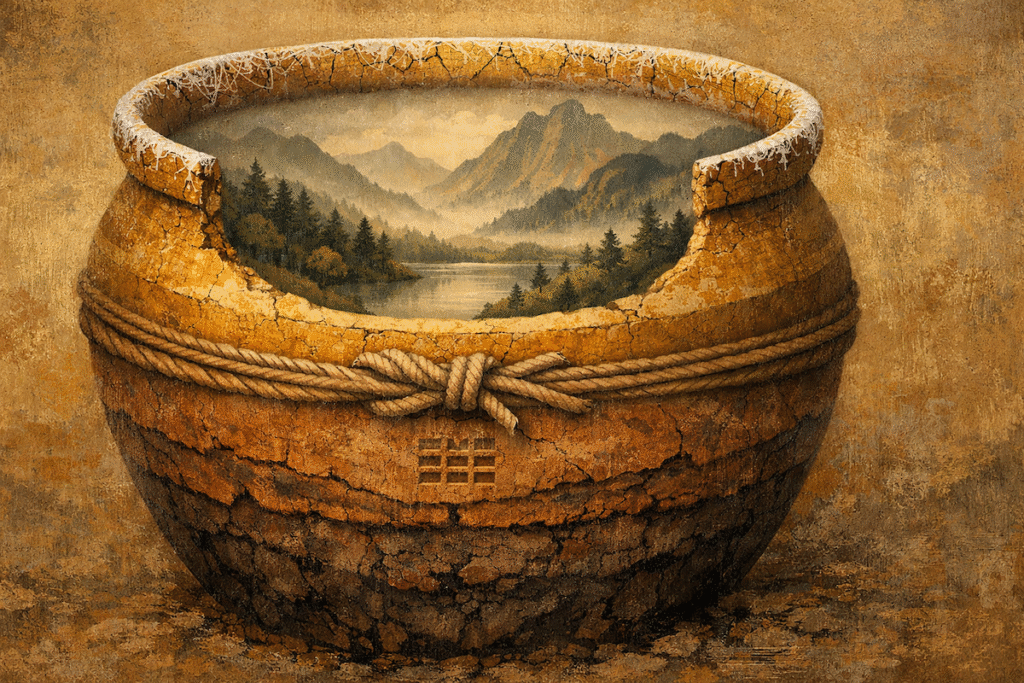
The Psychological Wisdom of the I Ching: Decoding the Receptive, Hexagram 2
- By YOWAYOW
The Psychological Wisdom of the I Ching: Decoding the Creative, Hexagram 1 :
https://yowayow.com/qian-hexagram-explained-as-a-psychological-model-of-will-and-responsibility/
Chapter 2: The Receptive (Kun)
The Architecture of Capacity
Subtitle: How to Build Deep Connection with Reality
(Radical Engagement with Reality)
0. Introduction: Not an evolutionary ladder, but a container that holds.
In Chapter 1 (Qian), we saw how a dragon flies from hidden depths to the highest heavens: a linear path about time and evolution.
But in Kun, there is no such thing as “evolution.”
The earth doesn’t need to evolve, the earth only needs to exist.
The six lines of the Kun hexagram represent six stages of human growth, and also six different “structures of bearing.”
Life presses against us in many forms: sometimes as faint signals, sometimes as great chaos, sometimes as lethal attacks, sometimes as heavy emotions.
Facing different external circumstances, you can use different ways of bearing to catch what comes.
Most people’s suffering comes from rigid posture. You try to solve emotion with confrontation, or solve attack with endurance. This mismatch causes harsh collisions with reality.
This chapter will teach you how to stop those collisions. Once you possess these six structures of bearing, you no longer need to stay tensed against the world. Because no matter how reality presses toward you, you will always become the shape that exactly catches it.
Stage 1 (Line 1): The Sensing Structure
The Sensing Structure
“Receiving signals: when the world is still asleep, I already hear the echo.”
【Line Text】
Treading on frost, solid ice is coming.
【Archetype】
The Canary in the Coal Mine / The Night Watchman
The canary detects toxic gas before the miners; the night watchman senses an attack before the soldiers. It’s not because they are stronger, but because they are more sensitive.
In the Kun system, the first step is not action, it is “reading.”
“Treading on frost” means when your foot steps on the first thin layer of frost, your psychological container must immediately expand, because you are not just holding frost, you are holding the entire approaching winter (solid ice).
【Psychological Position】
You are in a high-bandwidth information-reception state.
In intimate relationships:
Your partner comes home smiling, but their eyes are 10% dimmer than usual. Most people overlook it, but something in you shifts. You know there might be huge pressure at their work, or a tiny crack in your relationship.
In bodily health:
Your body suddenly doesn’t want your favorite food, or you inexplicably want to sleep. This is your body sending a “system overload” signal.
In the workplace:
Your boss makes a joke in a meeting, everyone laughs, but you hear the warning beneath the words.
【In-Depth Analysis】
Pattern Recognition & Somatic Markers
Many people (especially those influenced by Qian-mode thinking) mistake this sensitivity as “weakness” or “nervousness.” But here we redefine it: sensitivity is a high-level survival intelligence.
Your subconscious processes massive data in the background, then delivers a result through intuition (treading on frost).
The psychological task at this stage is: trust your discomfort.
Don’t suppress intuition with logic, let your container receive these faint signals and begin preparing.
【The Shadow】
The Anxious Prophet
“Oh no, something bad is going to happen again.”
If you only sense without processing, you will be overwhelmed by signals. You might turn one look into a full blown breakup drama and freeze in the moment.
【Action Guide】
The Pause of Validation:
When you feel something is off, stop, don’t rush to react. Ask:
“The atmosphere feels a bit off — what’s happening?”
Make invisible information explicit.
Pre-emptive Self-Care:
If you feel tired, stop immediately, don’t wait until you get sick. Put on your coat when frost appears, not when ice has formed.
【Progression Signal】
You’ve progressed when you can calmly say to yourself:
“I know something is about to happen, and I am prepared.”
Stage 2 (Line 2): The Grounding Structure
The Grounding Structure
“Carrying essence: I don’t have to change shape to fit the world, I let the world flow through me.”
【Line Text】
Straight, square, great. Without practice, nothing is not beneficial.
【Archetype】
The Fertile Soil / The Natural
Does fertile earth need to go to class to learn how to carry mountains? Do fish need to practice to swim in water?
No.
“Without practice” means no deliberate effort or artifice is needed.
Your essence (straight), your principles (square), and your capacity (great) already align perfectly with the world.
You don’t need to perform being good, you are that foundation.
【Psychological Position】
You are in a state of mind–body integration flow.
In social settings:
You don’t need to prepare topics or force humor. You simply sit there sincerely, and people open up to you, because your straightness (authenticity) feels safe.
In decision-making:
You don’t need SWOT charts, your first instinct is often right, because your internal values (square) are clear and no conflict.
In life: You don’t compare yourself to others. Like the earth, you rest in your place, and resources and good fortune naturally flow toward you.
【In-Depth Analysis】
Congruence
This line describes psychological high congruence.
- Straight — internal motives are pure; what you want is what you pursue, without distortion.
- Square — external boundaries are clear; you know what you stand for and what you don’t.
- Great — the outcome is naturally expansive.
When in this state, there is no friction between you and reality. You don’t expend energy maintaining a persona; all saved energy becomes nourishment for life.
【The Shadow】
The Lazy Fatalist
“Anyway, this is who I am.”
If you misinterpret “without practice”, you might abandon necessary learning and growth, turning go with the flow into just getting by, wasting this fertile ground.
【Action Guide】
Stop Trying So Hard:
This week, when you find yourself struggling or tangled in effort, stop. Ask:
“Who am I trying to perform for?”
Return to the way that feels most natural and effortless. Trust that effortless self.
Own Your Square:
Write down three non-negotiables (e.g., honesty, health, sleep). Everything else you can embrace broadly. With clear boundaries, your openness has strength.
【Progression Signal】
You’ve progressed when you find you no longer envy anyone else’s life — and feel deep satisfaction with your own.
Stage 3 (Line 3): The Implementation Structure
The Implementation of the Structure
“Carrying the task: I am not the shining star — I am the engine.”
【Line Text】
Containing brilliance, one can remain correct. Perhaps follow the service of the king; no achievement, but there is an end.
Object of Bearing: Floating talent & concrete responsibility (Ego & Duty)
【Archetype】
The Pragmatist / The Silent Craftsman
Imagine someone in a noisy meeting room, the only person holding a pen and writing down what specifically needs to be done next.
He is not the CEO on stage painting big visions (like Qian), nor is he a silent invisible person (like Line 4).
He is the one who turns the big vision into flour and water.
He has substance within (containing brilliance), but he knows the current task is not to show “how much I know,” but to follow leadership’s direction (follow the service of the king) and get things done (have an end).
He is like the foundation — carrying the weight of the structure above, yet buried in the earth.
【Psychological Position】
You are in a “do more, speak less” practical phase.
At work:
When leadership gives a somewhat vague direction, you don’t nit-pick or flatter. You quietly break that vague idea into ten actionable steps and then execute them.
In family life:
Your partner gets excited about a trip and checks guides and posts on social media. You say nothing, you quietly book the tickets, arrange visas, and pack the bags.
Your mindset:
You convert the desire to be seen into the drive to accomplish tasks.
【In-Depth Analysis】
Functional Transformation
The psychological structure of this line is “input → transform → output.”
- Containing brilliance (input): You have talent and insight.
- Transforming: Instead of turning that talent into argument or display, you swallow it and digest it internally.
- Having an end (output): After digestion, what you produce is results.
This is a high degree of professional maturity.
The immature (like in Qian) want to prove “I am strong” —
but the mature (Kun, Line 3) use their talent to prove “this thing can be done.”
You carry the loneliness of being unrecognized, and in exchange, you achieve real completion.
【The Shadow】
The Passive Victim
“Why should staying silent make me seem mute?”
If you aren’t willingly implementing but are forced into silence, resentment builds.
You might work while mentally cursing leadership, and in the end, you complete the task but lose relationships.
【Action Guide】
Silence in Action:
This week at work, try replacing all “I think…,” “I feel…” with action.
When you want to argue, create a data sheet that proves your point and send it directly — no extra commentary.
The “Done” List:
Don’t care how many likes you get.
Before you leave work each day, look at your completed tasks list and tell yourself:
This is my badge.
Enjoy the grounding sense of “harvest in the granary.”
【Progression Signal】
You’ve progressed when you no longer feel compelled to explain “I actually did a lot”, because you deeply know that results themselves are the loudest noise.
Stage 4 (Line 4): The Sealed Structure
The Sealed Structure
“Carrying secrets: I know everything, but I have swallowed the key.”
【Line Text】
A tied-up sack. No blame, no praise.
Object of Bearing: High-stakes trust & danger (High-Stakes Trust & Danger)
【Archetype】
The Vault / The Keeper of Secrets
Imagine the chief steward in a royal palace, or a modern company’s legal partner.
He stands near the core of power (Line 4 is adjacent to Line 5), knows most of the inside story, and carries great talent (continuing from Line 3).
But he puts all of it into a tightly sealed black bag.
He neither displays his talent for praise (no praise), nor makes mistakes that leave handles for blame (no blame).
He is like an abyss, drop any secret in, and you hear no echo.
His safety comes from being airtight.
【Psychological Position】
You are in a high-risk silence zone.
This is not like Line 3’s say less, do more — this is complete non-action, complete non-speech on the surface.
At the executive level:
You may be entangled in high-level corporate struggles or know core secrets of an impending layoff. Any taking sides, any evaluation, even any show of sympathy could make you the scapegoat.
In complex relationships:
For example, you are the buffer between your husband and your mother-in-law. Anything said from one to the other gets distorted. You must become an information terminus, not a transmitter.
【In-Depth Analysis】
Self-Effacement
This is Kun’s most austere face. Line 3 still pursues “having an end” (completing tasks), but Line 4’s goal is downgraded to “no blame” (surviving).
Why? Because you are too close to the center.
Exposed talent invites jealousy; great achievement invites suspicion.
“A tied-up sack” is not just keeping quiet — it is actively removing your personality markers.
You must become transparent, bland, and without sharp edges.
You must use all your intelligence on appearing non-threatening.
This is a highly intelligent form of disguise.
【The Shadow】
The Cynic
“This world is too dark.”
Long-term pressure to play dumb can make a person bitter.
You may begin to trust no one and see everyone as a potential trap — sliding from caution into paranoia.
【Action Guide】
The Information Black Hole:
This week, practice being a black hole. When others try to pry information or gossip through you, don’t say “I don’t know” (which seems defensive).
Show real disinterest.
Cut off information flow, don’t let any message pass through you.
Neutralize the Success:
If you’ve recently achieved something significant (continuing Line 3’s merit), and the environment is sensitive:
Seal the sack.
No celebrations, no social media posts.
You can even intentionally self-deprecate a little to neutralize others’ envy.
【Progression Signal】
You’ve progressed when others say of you:
“Although this person doesn’t speak much, they’re tight-lipped and steady.”
That means you’ve survived the crisis and lived through danger.
Stage 5 (Line 5): The Sovereign Structure
The Sovereign Structure
“Carrying power: I do not sit on the throne, I am the throne itself.”
【Line Text】
Yellow lower garment brings supreme good fortune.
Object of Bearing: The destiny of the entire system
【Archetype】
The Regent / The Spiritual Leader
“Yellow” is the balanced, central color of the earth, and “lower garment” refers to humble attire worn below the waist.
This creates a powerful image: one who holds the highest position, yet wears modest clothes.
The king of Qian wears shining armor and stands on the ramparts wielding his sword;
the sovereign of Kun wears simple cloth and sits in an inner chamber drinking tea.
But he doesn’t need to brandish a sword, all swords obey him.
He is not the one charging into battle; he is the stabilizing star.
Through an unseen gravity, he maintains balance across the entire ecosystem.
【Psychological Position】
You are in the core leadership of the system.
You no longer need to execute like Line 3, nor avoid danger like Line 4.
You now hold real authority, but your use of it is entirely different:
In corporate leadership:
You are no longer the CEO absorbed in business details (that is the Qian role).
You are the chairman or the one who defines company culture.
You are responsible for creating a sense of security that allows the fierce frontline team (the Qian energy) to go fight.
In the family:
You are a respected elder. You usually don’t intervene in daily matters, but when a major issue arises, everyone looks to you.
As long as you simply nod, hearts remain steady.
【In-Depth Analysis】
Container Authority
This is the highest form of leadership in psychology: Holding Space.
Lower forms of leadership rely on control; higher forms rely on containment.
As Line 5, your psychological structure is a vast container.
You must absorb subordinates’ mistakes, market turbulence, and even betrayals.
You take these confusions in, and with your steadiness (yellow) and humility (lower garment), you dissolve them.
Supreme good fortune occurs because you have created a space that allows growth.
In this space, everyone feels like the lead actor, while you become the invisible air that makes it all possible.
【The Shadow】
The Weak Ruler / The Permissive One
“For the sake of harmony, I refuse to play the villain.”
If you have only humility (lower garment) without central correctness (yellow) then you become a pushover.
You will tolerate corruption and laziness for the sake of superficial peace.
Your tolerance becomes weakness, and eventually the system decays.
【Action Guide】
Radical Humility:
Your position is high, precisely because of that, you must appear lower than everyone.
Give all credit to those in the front line (Qian energy), and take responsibility yourself.
This is not hypocrisy, it reduces internal friction.
Only when you are an “empty valley” will talent flow toward you.
The Stabilizer:
When the team or family panics, don’t rush to provide solutions.
Sit there and maintain extreme calm.
Your breath, your speaking pace, and your gaze must convey:
“It’s okay, this won’t collapse.”
Your calmness is the highest form of power.
【Progression Signal】
You’ve progressed when you realize that you haven’t issued any directive, yet things naturally unfold in the direction you hope for, because your “field” has already been properly tuned.
Stage 6 (Top Line): The Collapsed Structure
The Collapsed Structure
“Carrying destruction: when the earth tries to become a hammer, the world shatters.”
【Line Text】
Dragons fight in the wild; their blood is dark yellow.
Object of Bearing: Unchecked ambition & systemic failure
【Archetype】
The Usurper / The Tectonic Rupture
Imagine two dragons locked in mortal combat in a wasteland. One is the true dragon (symbolizing creative force/Heaven), and the other is a pseudo-dragon that the earth has forcibly tried to become (symbolizing receptive force/Earth). This defies natural order: the earth, which should carry all things, rolls itself up and attempts to strike the sky.
The result is not a victor, but rather “their blood is dark yellow”, the mingling of heaven’s dark color and earth’s yellow color. This symbolizes chaos in the order of heaven and earth and the disappearance of boundaries. There is no winner in this battlefield of destruction.
【Psychological Position】
You are in a phase of mutual destruction and collapse.
This typically happens when a supporter or bearer (the Kun type) decides to completely turn against the system.
In power struggles:
A second-in-command (or partner) who was once a supporter becomes dissatisfied with merely assisting and believes they are stronger than the leader, so they spark a brutal takeover battle. The outcome is often a paralyzing stalemate and mutual harm.
In intimate relationships:
A long-suffering partner suddenly goes dark. It stops being about “we want a good life,” and becomes “I will make you pay.” Custody battles, asset transfers, and reputation destruction follow.
Mindset:
You abandon win-win thinking and enter a zero-sum war.
【In-Depth Analysis】
Enantiodromia & Role Displacement
In psychology there is a concept that anything taken to an extreme turns into its opposite. When Kun reaches the top line, the yin force has peaked and begins to decline. You may have been a container (bearer) for a long time, bottling up grievances or unfulfilled energy. When these energies can no longer be digested internally, you attempt to release them by imitating the opposite force — becoming more aggressive, rigid, and combative than the true creative force.
This is fatal, because your essence is space and receptivity, not the creative force and decisive energy of the true dragon. Attacking with your own weakness (aggression) against others’ strengths is not just failure: it is self-alienation. You are no longer the broad earth, and you cannot become a dragon; you become a chaotic mess of blurred colors and disordered force.
【The Shadow】
The Nihilist Destroyer
“Since I can’t get recognition, we’ll all die together.”
This is horrifying destructive force. You no longer care about building, only inflicting pain. You destroy not just your opponent, but the very stage (system) you depend on for survival.
【Action Guide】
Cease Fire Immediately:
If you find yourself in a “I just want to destroy the other side” state, recognize that you are bleeding your own life force. At this stage, no strategy leads to victory. The only way to save yourself is total retreat.
Acknowledge that this relationship or project is dead, and walk away with whatever remains of your strength, do not continue the fight.
Return to the Root:
Ask yourself: “Why did I start this in the first place?”
Return to the essence of the earth: growth, not killing.
Even if it means beginning again from scratch.
【Progression Signal】
This line has no signal of advancement, only an exit signal.
The progression signal is the moment you realize:
“If I keep fighting, I will become a monster myself.”
Put down the sword and walk away. That is your last trace of compassion.
Chapter 2 Conclusion — On the Wisdom of Living
The six lines of Kun have now been traversed.
From the sharp perception of frost underfoot, to the relaxed vastness of straight, square, and great;
from the transformation of hidden brilliance to the sealed containment;
from the leader in yellow lower garments, and finally to the warning of dragons fighting in the wild.
These six structures together form our complete set of tools for meeting reality.
Qian taught us how to “make things happen.”
Kun taught us how to “let things pass.”
If you can skillfully use these containers, you possess the world’s strongest resilience.
You can not only fly, you can also land.
You can not only win, you can live.
But life does not stop.
When the will of Heaven (Qian) finally combines with the bearing of Earth (Kun), the first seed will break through the soil in hardship.
That is the initial pain of life, and also the most tenacious hope.
In the next chapter, we enter the third hexagram —
Zhun (Difficulty at the Beginning): The Psychology of How Everything Is Hard at the Start.
Want to explore more cards?
See the full list of I Ching Hexagrams →
All predictions and interpretations on this site are purely for entertainment purposes and should not be taken seriously.
If you have a personal question or dilemma, you’re welcome to submit it.
We choose a few questions to respond to from time to time. Some of these may be featured on our blog, anonymously.
Please note:
Not every question will receive a response.
There is no cost to submit a question.
Responses are intended to inspire reflection, not provide absolute answers.
If selected, your question may be shared on the site, without any identifying information.
Submit your question via email: ask@yowayow.com
By submitting, you agree that your question may be used for public exploration on our site, anonymously and respectfully.