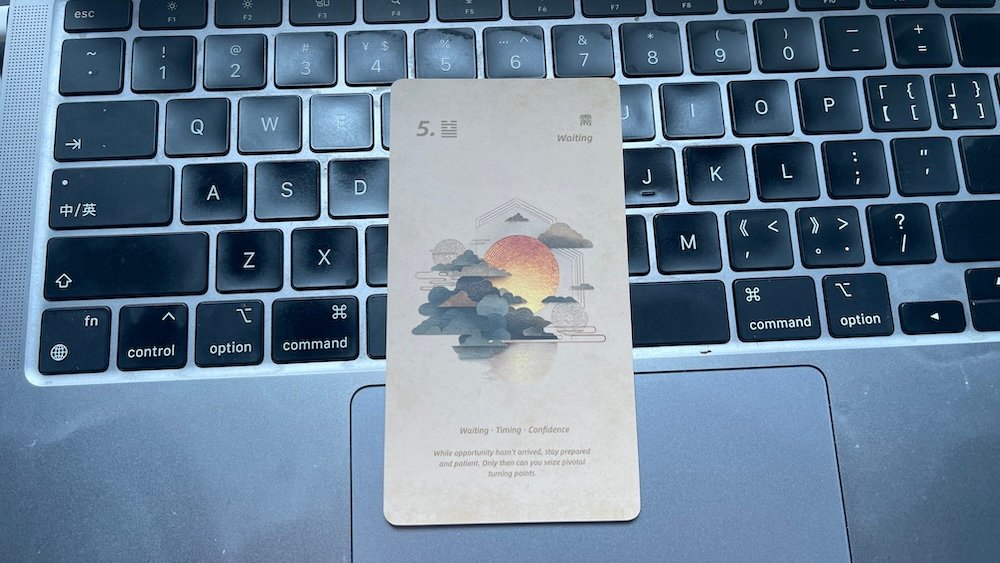
Chapter 5: Xu (Waiting) — The Art of Powered Standby
- By YOWAYOW
Why “Daring to Be Still” Is the Hardest Lesson of Your Life
Introduction: The Three Hardships of Beginning
In the evolutionary sequence of life within the I Ching, for any life form to establish a foothold in this cruel world, it must pass the “Three Hardships of Beginning”:
- Level 1 · Zhun (Sprouting): Conquering “Chaos.” This is obscurity at the survival level, like a seed struggling in frozen soil.
- Level 2 · Meng (Youthful Folly): Conquering “Confusion.” This is the fog at the cognitive level. (See our previous guide: Way-finding Through Fog: Hexagram 4).
- Level 3 · Xu (Waiting): Conquering “Attachment.” This is anxiety at the level of temperament and mindset.
“Xu” represents a requirement; it signifies seeking. If you do not understand its etymology, you will be misled by the standard translation of “Waiting.” The essence of the Xu hexagram is Need (Desire/Demand).
For a deeper dive into the symbols and history, check the Encyclopedia: Hexagram 5 Xu.
Its structural imagery is full of tension:
- The Lower Trigram is Heaven (Qian): Representing the vigorous, primal drive within you that intensely wants to achieve a goal. (Learn more about this energy in our Qian Hexagram Podcast).
- The Upper Trigram is Water (Kan): Representing the bottomless, danger-filled abyss in reality that blocks your way.
This constitutes life’s most hidden contradiction: Your energy (Qian) bursts outward, but the environment (Kan) is fraught with peril.
When you desperately want something, but reality completely disallows it, what do you do? Most people’s first reaction is to “grind blindly.” Yet, the Xu hexagram uses a brutal six-step deduction to tell you: grinding away in the wrong desire is suicide; but if you can traverse the cost of desire, you will find true settlement.
Preliminary Agreement: Three Stop-Loss Contracts
Before your desire consumes you, you must first sign the “underlying contract” written in the hexagram judgment:
[Hexagram Judgment]
Sincerity (Has Confidence). Shining success. Perseverance brings good fortune. It is beneficial to cross the great stream.
Principle One: Certainty — “Has Confidence (You Fu)”
- Mindset: Distinguish between “waiting” and “gambling.”
- “Fu” means faithfulness and sincerity. The first premise of Xu is: You must have absolute confidence that “the rain will eventually fall.” If your waiting is filled with the fear of “what if it never comes,” it shows you have not established “Fu.” Waiting without inner certainty is essentially a gambler placing a bet; such desire is not worth persisting in.
Principle Two: Value Addition — “Shining Success (Guang Heng)”
- Mindset: Distinguish between “accumulating momentum” and “internal friction.”
- Correct waiting (Xu) is a process of constantly increasing your value, even radiating light. If, during the wait, your energy shrinks, your state becomes dim, or even shameful, that is not “Waiting” (Xu)—that is “Exhaustion” (Kun). Any waiting that devalues you must be aborted immediately.
Principle Three: Instrumentality — “Beneficial to Cross the Great Stream”
- Mindset: Distinguish between “means” and “ends.”
- Why do we endure the torment of waiting? It is to “cross the great stream” (complete a high-difficulty leap). Waiting itself is not the goal; “accumulating strength to conquer obstacles” is the goal. If you merely wait on the shore without building a boat, you will never cross that river.
Part One: The Lower Trigram (Qian / Heaven Zone)
Psychological Overview: The Energy Idling Phase
“The event hasn’t happened yet, but your heart is already exhausted.”
In the structure of the Xu hexagram, the lower trigram is Qian (Heaven). This represents a psychological dimension of “High Drive, Low Output.” Because there is “nothing to do” externally, your unreleased energy converts into massive internal friction.
State Diagnosis: Anticipatory Anxiety
The characteristic of Qian is “vigor”—it cannot stop. When you constantly refresh messages, repeatedly revise a perfect plan, or worry about next year’s crisis, you are using “pretend effort” to mask inner panic. This is energy idling—the car isn’t moving, but you are stomping on the gas, and the engine is about to blow.
Anchor One (Initial Nine): Waiting at the Outskirts
“Facing the budding of original intent: do not make the dream too heavy.”
Line Text: Waiting in the outskirts. It is beneficial to use constancy. No blame.
- The Scene: Waiting in the wild outskirts far from danger. The best strategy is to maintain a constant life routine; in this way, there is no calamity.
- Archetypes: An athlete in the off-season / A general preparing for war / A farmer before the storm.
- Psychological Position: The “Outskirts Fantasy Phase”
Desire at this moment is beautiful because it has not yet incurred costs. The wisdom of Initial Nine lies in “using constancy”—maintaining normality. The mistake many make is getting overly excited as soon as a project starts, turning their lives upside down. This is “burning out the fuel before even setting off.” - Action Guide: Establish a “Constant Routine”
- Daily Checklist: Unshakably complete 3 basic tasks (reading, fitness, organizing data).
- No Drama: Do not sacrifice the order of your current life for a result that hasn’t even cast a shadow yet.
Anchor Two (Nine Two): Waiting on the Sand
“Facing the friction of reality: don’t let the grit wear down your mindset.”
Line Text: Waiting on the sand. There is some small gossip. Ultimately good fortune.
- The Scene: Waiting on the sandy beach near the water. Although it invites some murmurs of criticism (small gossip), as long as you persist, it is ultimately auspicious.
- Archetypes: A monk in the busy market / A questioned reformer / A person walking a muddy road in new shoes.
- Psychological Position: The “Initial Resistance Phase”
You have started moving. Sand gets in your shoes, slowing your pace. More annoyingly, voices of doubt appear around you. - Action Guide: Increase Bluntness
- The First Filter: The biggest taboo here is having a “glass heart” (fragile ego). In secular eyes, “stillness” equals “incompetence.”
- Physical Shielding: Smile, nod, and continue your wait. At this stage, feedback is all noise, no signal.
Anchor Three (Nine Three): Waiting in the Mud
“Facing deep-seated obsession: You perceive every shadow as a bandit.”
Line Text: Waiting in the mud. Invites the arrival of bandits.
- The Scene: Waiting in the riverside mud, the situation is difficult. Improper struggling exposes weaknesses and invites attacks.
- Archetypes: A beast stuck in a swamp / A boss with a broken capital chain / A gambler revealing their hand.
- Psychological Position: The “Defensive Attachment Phase”
This is the fatal junction. One of your feet is already stuck in the mud—you have invested too much and cannot pull out.
Why “Invites the arrival of bandits”? Because you are stuck in the mud (obsession), you act out of insecurity. You activate “Hyper-Defense Mode,” treating everyone around you as an enemy trying to steal your cake. It is your excessive desire that turns the world into a battlefield. - Action Guide: Disarm
- Admit being trapped: Stop hostility towards others.
- Stop thrashing: That “bandit” might be someone coming to save you, but your struggling has turned them into an enemy.
Part Two: The Upper Trigram (Kan / Water Zone)
Psychological Overview: The Energy Realignment Phase
“The event has finally happened, and your heart is strangely at peace.”
Crossing into the upper trigram, you truly enter the danger of Kan. The challenge here is no longer controlling impulses, but treating wounds and calculating the true price of “desire.”
Anchor Four (Six Four): Waiting in Blood
“Facing expensive costs: When the cost of winning exceeds the value of winning.”
Line Text: Waiting in blood. Get out of the pit.
- The Scene: You are already injured (waiting in blood). At this time, you must withdraw from this pit that constantly consumes you to save your life.
- Archetypes: A general who “kills a thousand enemies but loses eight hundred” / A “mortgage slave” draining savings to buy a house.
- Psychological Position: The “Cost Assessment Phase”
You are no longer daydreaming; you are bleeding. “Waiting in blood” reveals the cruelest side of desire: diminishing marginal utility and skyrocketing marginal cost. You originally strove to pursue happiness, but now, for the sake of striving, you have sacrificed happiness itself. - Action Guide: Cost Audit
- Do the math: If the price of the trophy is a broken leg, do you still make the trade?
- Stop the bleeding: Do not invest more fresh blood to recover previous losses. Jump out of the “pit.”
Anchor Five (Nine Five): Waiting with Wine and Food
“Facing inner reconstruction: I no longer ‘need’ that result.”
Line Text: Waiting with wine and food. Perseverance brings good fortune.
- The Scene: Waiting amidst feasting and enjoyment. Holding fast to the right path is auspicious.
- Archetypes: A feast after surviving a disaster / A sage reading in prison / Coffee in the trenches.
- Psychological Position: The “Self-Sufficiency Phase”
This represents a fundamental reversal of values. Before, you suffered because you felt “I can’t live without that thing.” Now, pained into wakefulness, you discover: even without that result, the sun still rises. You have let go of control over the outcome and regained the tangible reality of life. - Action Guide: Live Earnestly
- Ritual: Even if the world ends tomorrow, eat this meal well today. This unhurried relaxation is the cornerstone of rebuilding your life.
Anchor Six (Top Six): Entering the Cave
“Facing the final arrival: You’re ashore, but don’t expect calm seas.”
Line Text: Entering the cave. Three uninvited guests arrive. Honor them, and ultimately there will be good fortune.
- The Scene: Finally entering the cave (a place of rest), but three uninvited guests arrive. Treat them with respect.
- Archetypes: The old man who lost his horse (a blessing in disguise) / The person who brings bad news but also a turning point.
- Psychological Position: The “Post-Arrival Reality”
You thought you could close the door and enjoy stability. But fate disagrees. Just when you think it’s over, “uninvited guests” knock. There is no absolutely closed system in the world. - Action Guide: Open the Portal
- Honor them: The realm of the master lies in not being angry at the disturbance. Open the door and invite these accidents in. In the adult world, trouble often accompanies opportunity.
Conclusion: The “X-Paradox” of Xu
Reading through Xu, we discover a profound Inverse Relationship—an “X-shaped” paradox that defines our suffering:
- In the first half (Lower Trigram), it is “Restless Mind, Silent Field.”
Things haven’t started (Outskirts/Sand/Mud). Objectively, it is stagnant. But your heart is churning like overturning seas—anxious, debating, creating imaginary enemies.- This is energy idling.
- In the second half (Upper Trigram), it is “Silent Mind, Violent Field.”
Things have happened (Blood/Endgame). Objectively, it is intense and dangerous. But your heart returns to tranquility—stopping losses, enjoying wine, welcoming guests.- This is energy realignment.
The ultimate cultivation of Xu is to flatten this curve: Cultivate “Stillness” when things stop; cultivate “Stability” when things move.
However, the story does not end.
When you “Enter the Cave” and open the door to welcome those three “uninvited guests,” a new plot unfolds. Since guests have arrived, exchanges of interest and collisions of viewpoints are inevitable. You cannot hide alone in the cave forever; you must walk into the crowd to game and bargain.
In the next chapter, we will have to put away the wine glass and walk into the battlefield that tests logic and principles the most—Song (Conflict).
Want to explore more cards?
See the full list of I Ching Hexagrams →
All predictions and interpretations on this site are purely for entertainment purposes and should not be taken seriously.
If you have a personal question or dilemma, you’re welcome to submit it.
We choose a few questions to respond to from time to time. Some of these may be featured on our blog, anonymously.
Please note:
Not every question will receive a response.
There is no cost to submit a question.
Responses are intended to inspire reflection, not provide absolute answers.
If selected, your question may be shared on the site, without any identifying information.
Submit your question via email: ask@yowayow.com
By submitting, you agree that your question may be used for public exploration on our site, anonymously and respectfully.