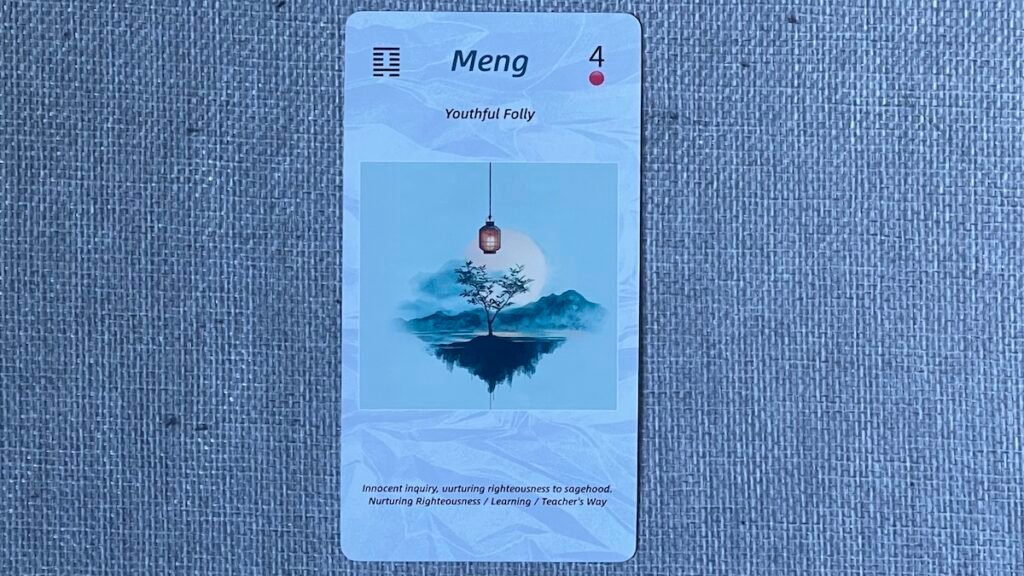
Way-finding Through the Fog: I Ching Hexagram 4 Guide
- By YOWAYOW
Within the system of the I Ching, the Meng hexagram (Mountain over Water) presents two fundamental forms of the unknown, determined by its structure:
- The Upper Trigram is Mountain (Gen), representing stillness and obstruction.
- The Lower Trigram is Water (Kan), representing flow and danger.
This is not merely a physical configuration, but a map of two inner dimensions of confusion. The six lines of Meng form a targeted diagnostic and treatment protocol:
- Dimension A (Lower Trigram · Water): Disarray. Your state is chaotic. Emotions spread like floodwater; actions rush without direction. You are easily swept along by circumstances. This is the challenge of Behavior and Emotion.
- Dimension B (Upper Trigram · Mountain): Blockage. Your state is stuck. Thinking becomes rigid like a wall; cognition seals itself off. You may be trapped in a mental corner or arrogance. This is the challenge of Cognition and Thought.
Within the system of the I Ching, the Meng Hexagram (Hexagram 4) presents two fundamental forms of the unknown…
Three Psychological Contracts of Enlightenment
Before navigation begins, one must sign the foundational contract written into the Hexagram Judgment:
Hexagram Judgment: Success. It is not I who seek the ignorant youth; the ignorant youth seeks me. The first consultation brings instruction; repeated inquiries are disrespectful—then no instruction is given. Favorable to perseverance.
Principle One: Agency
“It is not I who seek the ignorant youth; the ignorant youth seeks me.”
Mindset: Whoever suffers must be the one to initiate change. Do not expect a savior to descend from the sky; you must extend your hand first.
Principle Two: Intuition
“The first consultation brings instruction; repeated inquiries are disrespectful.”
Mindset: Trust your first intuition. Repeatedly asking “Is it really so?” is not a search for truth but a demand for emotional reassurance. At that moment, silence is the only remedy.
Principle Three: The Right Path
“Favorable to perseverance.”
Mindset: In confusion, the greatest taboo is constantly changing course. Choose one direction (perseverance), and walk it plainly to the end. That is success.
Part One: The Water Zone (Kan) — Managing Chaos
Psychological Overview: Immersion and Struggle
“At this moment, you are not on the shore. You are in the water.”
The lower trigram is Kan (Water). It represents a state of high dynamism and low order. When you are here, you are not standing above the maze—you are inside it.
State Diagnosis: Emotional Entropy
When life feels out of control, anxiety seeps in like a rising tide. Your judgment is hijacked by emotion. This is a high-entropy state: everything is dissipating, everything is uncertain.
Survival Strategy: The Anchoring Effect
Do not try to search for a grand vision while you are drowning. You do not need a perfect blueprint; you need a grip.
Step 1: The Anchor Rule (Initial Six)
Theme: Facing the chaotic self — Anchoring self-discipline through external discipline.
Line Text: Initiating ignorance. It is beneficial to apply discipline and punishment, to remove the shackles. To proceed otherwise leads to regret.
The Psychology:
You are in a vacuum of order. Your energy is leaking due to anxiety. At this moment, do not pursue “freedom”—that is self-destruction. You must introduce an external scaffold.
- Action Guide: Plant a Stake. Don’t try to untangle all the chaos at once. Drive down one immovable rule. Even if your mood is terrible, execute this one rule (e.g., “I must list my Top 3 tasks at 9 AM”).
- The Shift: When the “rigid rule” that felt painful becomes the very thing that makes you feel safe.
Step 2: Radical Acceptance (Nine Two)
Theme: Facing the chaos of others — Be a rock in the raging current.
Line Text: Embracing ignorance brings good fortune. Accepting the feminine brings good fortune. The child becomes capable of managing the household.
The Psychology:
You are in a phase of “downward compatibility.” You might be the only clear-headed person in a panicked team or family. Your task is not to crush their foolishness, but to metabolize it. Like a riverbed, you must allow the chaotic water to flow without breaking.
- Action Guide: Delayed Judgment. When someone makes a stupid mistake, physically shut up. Hold back the sarcasm. Acknowledge the emotion first (“I know you are anxious”), then address the logic.
- The Shadow: The Arrogant Savior. If you help with contempt in your eyes, you fail.
Step 3: Resisting False Idols (Six Three)
Theme: Facing temptation — Do not drink poison to quench your thirst.
Line Text: Do not take such a woman. Seeing the man of wealth, she loses her own bearing. Nothing is beneficial.
The Psychology:
This is the zone of Identity Panic and FOMO (Fear Of Missing Out). Feeling weak, you desperately want to latch onto a “Man of Gold”—a guru, a trend, or a get-rich-quick scheme. The line warns: “Losing her own bearing.” You are not learning; you are dissolving into someone else’s script.
- Action Guide: The Temptation Circuit Breaker. When you feel a strong urge to imitate someone or buy a “magic solution,” force a 3-day cooldown. Ask: “If I remove the fame and profit this promises, do I still value it?”
- The Shift: When you watch others frantically chase trends, and you feel relief rather than anxiety.
Part Two: The Mountain Zone (Gen) — Breaking Stagnation
Psychological Overview: Detachment and Awareness
“At this moment, I am no longer the fog, I am the one watching the fog.”
The upper trigram is Gen (Mountain). You have left the danger of drowning, but now you face a new crisis: Stagnation. You are calm, but you cannot move. The challenge here is cognitive—arrogance, closure, and rigidity.
Step 4: Smashing the Echo Chamber (Six Four)
Theme: Facing the isolated self — Acknowledging vulnerability is the beginning of breakthrough.
Line Text: Trapped in ignorance — regret.
The Psychology:
You are in a cognitive bottleneck. You are diligent, but you are stuck in an echo chamber. You are using old maps to explore new territory. The “regret” comes from unnecessary suffering caused by pride. You refuse to ask for help because you fear looking weak.
- Action Guide: Brute-Force Wall Breaking. Find a “Wall-Breaker”—someone outside your usual circle. Say the incantation: “I am stuck. This is how I’m thinking… where am I going wrong?”
- The Shift: When you can openly say “I don’t know, please teach me” without shame.
Step 5: The Beginner’s Mind (Six Five)
Theme: Facing truth — Lowering dimensions voluntarily to be reborn.
Line Text: Innocent ignorance brings good fortune.
The Psychology:
This is the “Empty Cup” phase. Six Five represents a leader or expert who chooses to press the reset button. When experience becomes a burden, you must return to the state of a child. You choose not to know, in order to see more.
- Action Guide: “Fool-Level” Questioning. In your next high-level meeting, drop your status and ask the most essential question: “Explain this to me as if I were five years old.”
- The Shadow: Performative Humility. Nodding while inwardly dismissing others. True innocence is in the eyes, not the nod.
Step 6: The Circuit Breaker (Top Nine)
Theme: Facing hardened boundaries — Severity is the final form of compassion.
Line Text: Striking ignorance. It is not beneficial to act like a bandit; it is beneficial to defend against bandits.
The Psychology:
Sometimes, ignorance becomes stubborn and destructive. Tolerance (Nine Two) and guidance (Six Five) have failed. Reasoning is now a weakness. You must apply a “Wake-up Strike.”
- Action Guide: Thunderous Methods, Bodhisattva Heart. Set a final red line. If it is crossed, apply immediate, high-intensity consequences. But remember: do not act like a “bandit” (out of anger). Act to defend the order.
- The Shift: When you can bring down the sword of consequence with no personal anger, only the calm precision of a surgeon.
Conclusion: Becoming Your Own Teacher
Looking back at Meng, this is not merely a manual on how to manage teams. It is the ultimate method of self-enlightenment. Within every one of us lives a confused student.
True growth is awakening the teacher within yourself who knows how to switch modes:
- When you are chaotic: Use the Ruler (Line 1) to anchor yourself.
- When you are anxious: Use the Riverbed (Line 2) to accept yourself.
- When you are greedy: Use the Mirror (Line 3) to check yourself.
- When you are stuck: Use the Key (Line 4) to open the door.
- When you are arrogant: Use the Empty Cup (Line 5) to reset.
- When you are stubborn: Use the Thunder (Line 6) to wake up.
Firm yet gentle. Lenient yet strict. When you can establish this dialogue between the inner teacher and the inner child, you will never truly get lost in the fog.
Next Chapter: Now that the road is visible, should we sprint? Not so fast. The next lesson is Xu (Waiting): The art of active patience and nourishment.
Want to explore more cards?
See the full list of I Ching Hexagrams →
All predictions and interpretations on this site are purely for entertainment purposes and should not be taken seriously.
If you have a personal question or dilemma, you’re welcome to submit it.
We choose a few questions to respond to from time to time. Some of these may be featured on our blog, anonymously.
Please note:
Not every question will receive a response.
There is no cost to submit a question.
Responses are intended to inspire reflection, not provide absolute answers.
If selected, your question may be shared on the site, without any identifying information.
Submit your question via email: ask@yowayow.com
By submitting, you agree that your question may be used for public exploration on our site, anonymously and respectfully.